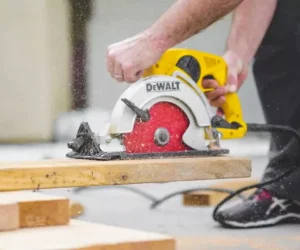
Cutting, grinding, drilling, and breaking concrete, brick, and stone generate respirable crystalline silica—microscopic particles small enough to penetrate deep into the lungs. According to the CDC and NIOSH, these particles can cause silicosis, lung cancer, COPD, and other serious diseases.
Once inhaled, silica dust can lead to:
- Silicosis (an incurable and sometimes fatal lung disease)
- Lung cancer (classified as a human carcinogen by IARC and NIOSH)
- Chronic obstructive pulmonary disease (COPD)
- Kidney disease and autoimmune disorders
(Reference: OSHA Crystalline Silica Standard – https://www.osha.gov/silica-crystalline)
What makes silica especially dangerous is that serious disease continues to occur at or even below many current exposure limits. OSHA notes that long-term exposure, even at regulated limits, can still pose significant health risks over a working lifetime.
The Problem With Basic Disposable Masks
The Problem With Basic Disposable Masks
Simple single-strap “dust masks” are often mistaken for protection, but they are not respirators, are not NIOSH-approved, and should never be used where silica is present.
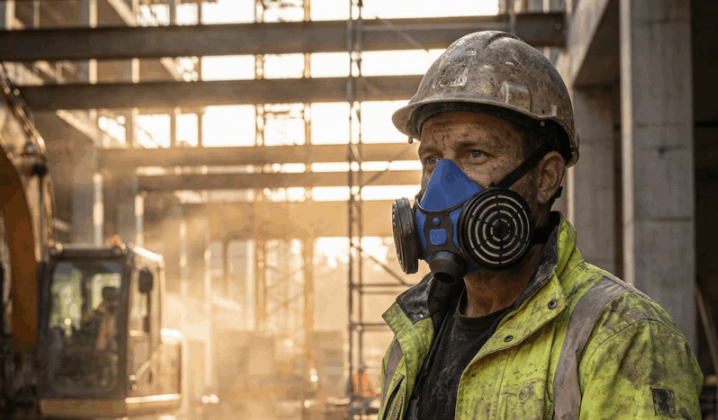
Even certified disposable N95 respirators only provide protection when everything goes right: a tight facial seal, proper fit testing, correct donning, and use within environmental limits for heat, humidity, and dust load. On real jobsites—especially hot, wet, and high-dust environments—these conditions are rarely met.
Workers frequently reuse clogged masks, wear them under the nose, over facial hair, or with poor strap tension. Each of these common practices breaks the seal and drastically reduces the protection factor, leaving workers exposed despite wearing “PPE.”
Why Workers Often End Up Underprotected
Silica is hazardous at very low airborne concentrations (for example, 0.05 mg/m³ in Ontario and Alberta, and 50 µg/m³ in the U.S.). By the time dust is visible in the air, exposures are almost certainly above safe limits.
Many worksites rely on respirators as the first line of defense instead of first reducing the dust itself. The most effective approach is to control silica at the source using methods like wet cutting, on-tool dust extraction, and local ventilation. When these controls aren’t used properly, respirators—especially disposable ones—are exposed to more dust than they were designed to handle.
Another common issue is that respiratory protection programs are not consistently followed. Air levels may not be regularly measured, fit testing may be skipped, and workers may not receive proper training on how to wear, check, and maintain their respirators. Without these steps, even approved respirators cannot provide their full level of protection.
As a result, workers may believe they are protected, when in reality their respirator is not performing as intended under real jobsite conditions.
Why Reusable Elastomeric Respirators Offer More Reliable Protection

As silica exposure increases, guidance consistently shifts toward tight-fitting half-face and full-face respirators equipped with high-efficiency filters such as N95s & P100s. These systems provide higher assigned protection factors and more consistent performance when properly fit tested and maintained.
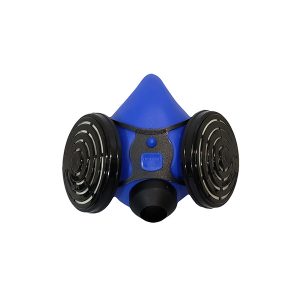
Reusable respirators are specifically designed for demanding environments where fine dust exposure is frequent and sustained. Their durable face seals maintain consistent contact with the skin, reducing leakage caused by strap fatigue, moisture, and repeated use. Designs like Dentec’s Comfort-Air® half mask respirators also incorporate features such as lightweight facepieces, low breathing resistance, and replaceable filter assemblies to support long shifts and improve worker compliance.
For example, Comfort-Air® Series half-mask respirators are commonly used across construction, manufacturing, and remediation industries and are built to maintain a reliable seal and allow filters to be replaced as dust loads increase. This ensures consistent protection without requiring workers to rely on single-use products that degrade quickly in high-dust conditions.
In addition to improved protection, reusable respirators help reduce waste and lower long-term costs, while providing a more stable and dependable solution for environments where silica exposure is part of routine operations.
NIOSH N95 REUSABLE RESPIRATORS


Practical Steps for Better Silica Protection
Silica should be treated with the same seriousness as other long-latency hazards:
- Control dust at the source first using wet cutting, on-tool extraction, and isolation
- Match respirator type and filter to measured exposure, not just task category
- Eliminate single-strap dust masks anywhere silica is present
- Set a minimum standard of NIOSH-approved, fit-tested respirators, escalating to reusable elastomeric half- or full-face models for higher-risk work
- Operate a real respiratory protection program, including air sampling, annual fit testing, clean-shaven policies for tight-fitting respirators, and worker training on donning, seal checks, cleaning, and filter change-out
Silica safety isn’t optional. It’s an investment in long-term lung health.